Three-day prison sentences spark Haredi protests against draft enforcement
Protests erupted after three yeshiva students were sentenced for failing to enlist, while leaders negotiate a potential coalition with Gadi Eisenkot.
By Nicholas Campbell ·
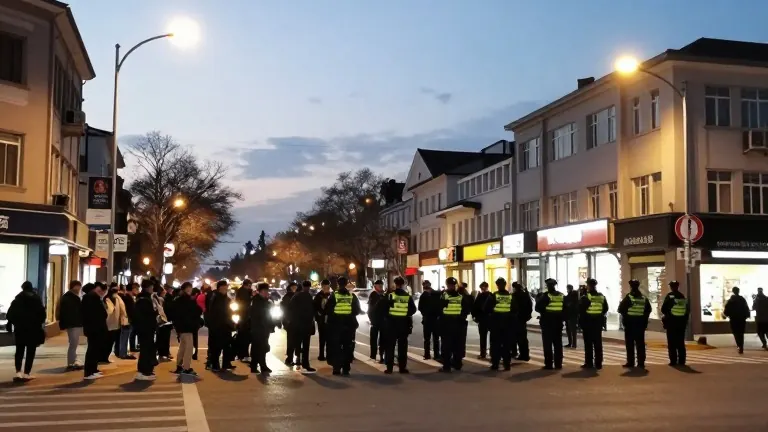
Dozens of Haredi protesters blocked the light rail on Jaffa Street in Jerusalem and a road outside Beit Shemesh on Wednesday evening. The demonstrations followed the detention of ultra-Orthodox students who had not completed mandatory military service. Police declared both protests illegal and used force to disperse the crowds.
According to Kikar HaShabbat, the immediate trigger for the unrest was the arrest of three students from a Jerusalem yeshiva. Officers stopped the men on Route 90 during the overnight shift from Monday to Tuesday while they were driving back from the Dead Sea. Police found that the men had standing draft orders. The court subsequently sentenced them to 20 days in military prison. The specific reason for the initial traffic stop was not specified.
Violence broke out during the Wednesday evening demonstrations. Rioters threw a stone that hit i24 reporter Shany Weitzman in the head. A metal rod was used to attack i24 photojournalist Nadav Abbas. Police confirmed the incidents and the injuries sustained by the journalists.
These events are the latest in a series of clashes related to Haredi draft enforcement. On November 1, protesters clashed with police near the Mea She'arim neighborhood in Jerusalem after the arrest of a draft dodger. On October 29, hundreds of Haredi men blocked Route 4 near Bnei Brak. Three protesters were arrested during that incident, and three police officers were wounded.
As the protests unfolded, Channel 12 reported that Rabbi Moshe Hillel Hirsch authorized ultra-Orthodox representatives to begin negotiations with the bloc led by Gadi Eisenkot. The talks aim to form a government and resolve the legal status of yeshiva students. Hirsch stated that securing legal status for these students is the top priority, ranking above restoring funding or reversing financial sanctions on Haredi institutions.
"The most important thing right now is for the yeshiva students to be legal," Hirsch said when asked about the potential agreement with Eisenkot. He expressed skepticism about the likelihood of success. "I don't see it as very realistic that we can reach agreements with Eisenkot," he said, but added that it is possible to proceed if an agreement can be reached.
United Torah Judaism MK Yaakov Asher met with Avigdor Liberman, chairman of Yisrael Beytenu, at the Knesset on Wednesday. The meeting was part of efforts to formulate a draft-law compromise acceptable to Haredi leaders and the anti-Netanyahu bloc. The sides stated that formal negotiations were not yet underway. Moshe Gafni, a former MK and head of the Degel HaTorah faction, has been working to stop his party from joining the Eisenkot-led government.
Gafni has held a series of conversations inside and outside the party in recent days to prevent an agreement. His successor, Asher, is the leading force within Degel HaTorah pushing for cooperation with Eisenkot's camp. Gafni was removed as Degel HaTorah leader before the October election after nearly four decades in the Knesset. Senior rabbinic leader Dov Lando said the party's slate needed to be refreshed, while reports indicated the change was also driven by internal disagreements over political direction.
New United Torah Judaism MK Eliakim Stark has voiced positions that differ from most of his party members. Stark supports the study of secular subjects in schools, backs ultra-Orthodox soldiers, and encourages mass employment alongside Torah studies. He lived in Belgium until age 16 and is familiar with ultra-Orthodox life outside Israel, which often includes working and studying secular subjects.
In an interview with Channel 13, Stark said he wants to care for hundreds of thousands of young Haredim who want employment opportunities. "We have to help them. There will be thousands, if not tens of thousands, more families earning a living," he said. He noted that if Haredim want to study core subjects, they must be given adapted opportunities. Stark, a member of the Belz Hasidic sector, said cooperation with any Knesset party, including Arab-led parties, is legitimate if it serves the Haredi interest.