
Manx shearwaters show a seven-degree navigation error during transatlantic return flights
Data from GPS trackers suggests seabirds experience a mild version of jet lag, causing slight course deviations on their 600-mile journeys home.
By Nicholas Campbell ·
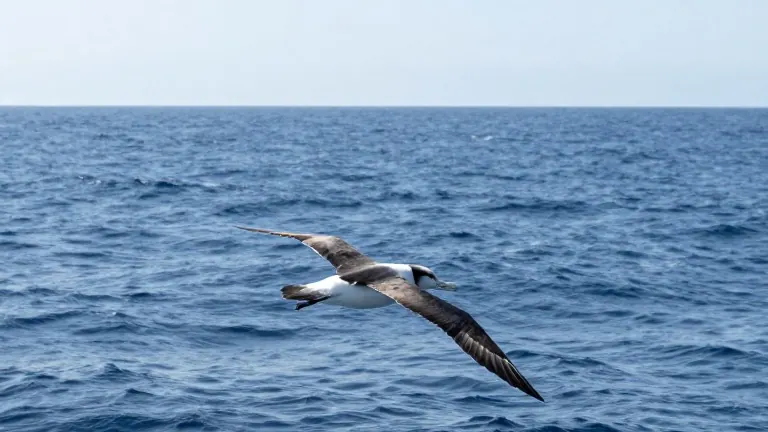
A new study published in Science indicates that Manx shearwaters experience a physiological delay similar to human jet lag when crossing the Atlantic. The research points to a mismatch between the birds' internal biological clocks and the local solar time as the cause of navigational drift during long-distance flights.
Manx shearwaters are common in the British Isles and share a close evolutionary lineage with albatrosses. They form lifelong pairs and produce a single egg per breeding season. One partner incubates the egg continuously while the other forages in the North Atlantic for fish and squid. These foraging trips can last up to two weeks and cover hundreds of miles from the nest.
Patrick Lewin, a behavioral ecologist at the University of Oxford, noted that once fully fed, the birds return to their colonies rapidly, often completing the trip in a single day. This speed raised the question of whether the birds suffered from what Lewin termed flap lag. To test this, Lewin analyzed two decades of GPS tracking data collected by his colleagues.
The shearwaters rely on the sun for navigation. Accurate heading requires knowing the local time of day to interpret the sun's position. If the bird's internal clock is out of sync with the actual solar time, the calculated compass bearing will be incorrect. Lewin and his team observed that the birds veered slightly off their direct path back to their partners and eggs.
The maximum deviation recorded was seven degrees. Over a 600-mile journey, this angular error resulted in a physical deviation of approximately three miles. Lewin described the impact as a really small addition to the total distance flown. The finding confirms that the birds' internal timekeeping affects their real-world movement patterns in a measurable way.
Alice Boyle, a biologist at the Centre for Animals on the Move at Western University in Ontario, praised the work. She noted that while nearly all animals must navigate their environments, studies showing these decisions in action are rare. Boyle emphasized the value of using wild birds in remote areas to learn about biological processes. She called the paper so cool, highlighting the insights gained from tracking behavior in the wild.
The study provides concrete evidence that circadian rhythms influence navigation in avian species. The data shows a direct link between internal clock synchronization and flight accuracy. The findings add a new layer to the understanding of how seabirds manage long-distance travel across time zones.
Source: KWMU
More Business · Bad Service · Report a business · Got a Story?