Spain's Transport Minister Blames Controller for Toledo Train Crash That Killed 69
Railway unions counter that aging infrastructure and understaffed control rooms contributed to the second major collision on the Madrid-Seville line this year.
By Valentina Rojas ·
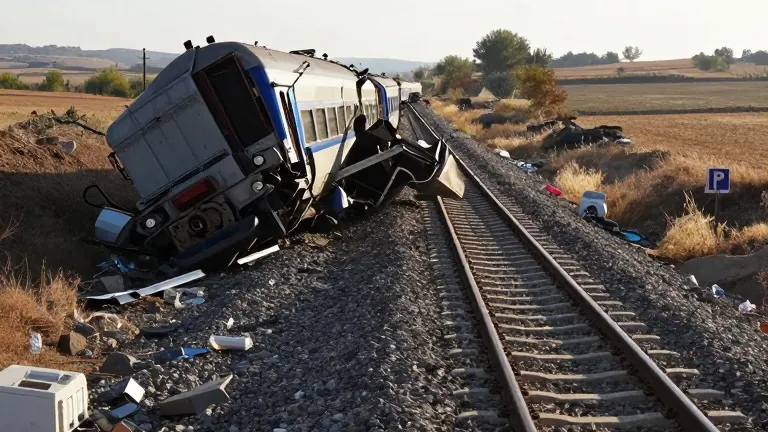
A communication failure on a high-speed rail line in central Spain left human operators managing traffic without digital assistance, leading to a collision that claimed 69 lives on Wednesday. The incident marks the second deadly crash on the Madrid to Seville corridor within months.
Spanish authorities say the automated LZB system, which monitors train positions and triggers automatic braking, went offline at 8:30 a.m. on Wednesday. This forced controllers at a post in Madrid to manually oversee a 63-kilometer stretch of track between Madrid and Seville. Officials estimate that six trains were operating on that section when the system failed.
At 8:36, a controller authorized a state-owned RENFE train to resume normal speed. A privately operated IRYO train, located 25 kilometers down the line, attempted to restart but could not override its automatic stop signal. The engineer informed the controller of the issue. At 8:53, the two trains collided, derailing carriages and causing extensive structural damage.
Transport Minister Oscar Puente attributed the disaster to a specific decision made by the traffic controller. He described the order to restart the RENFE train as erroneous and inexplicable, noting that a red stop signal remained active on the line. Puente told reporters that the decision was made in inexplicable circumstances while another train remained stopped.
Railway unions challenge this assessment, arguing that the controller was operating under significant strain. Raquel Ayllon, a spokesperson for the SCF railway traffic controllers union, stated that human error is less surprising given years of requests for more personnel and recurring safety system failures. She argued that the incomprehensible aspect is the regular failure of the safety infrastructure rather than the individual worker.
Diego Martin, a spokesperson for the SEMAF union of train engineers, pointed to the age of the LZB system, which has been in use for three decades while being phased out. He noted that the system has gone offline repeatedly in the past and should have been replaced sooner. Train workers went on strike on Thursday to demand better safety conditions following the January crash, which killed 46 people when a train jumped the tracks and hit an oncoming vehicle.
Spain opened its high-speed rail network to private operators in 2021, ending a period of exclusive state service. Both collisions this year involved one RENFE train and one IRYO train. According to SCF data, average daily trips between Madrid and Barcelona increased from 56 to 89 between 2019 and 2024. Union representatives suggest this rise in traffic has placed additional strain on the network, though they acknowledge it is not the sole factor in the crashes.
A judge and a special government commission are conducting separate investigations into the Toledo collision. Prime Minister Pedro Sanchez has pledged to determine the root causes of the accident. King Felipe VI visited injured passengers in a Toledo hospital on Thursday and stated that measures must be taken to prevent a recurrence.
Source: MySA